
This page won’t tell you that French is a romantic language. It covers three things you can count: what French gets you in Canada, how many immigration points it adds, and what it changes in practice at work and in daily life.
French in the world
| Item | Figure |
|---|---|
| Speakers worldwide | about 320 million (OIF 2022; OIF’s more recent 2026 report gives about 396 million) |
| Distribution | all five continents |
| Working language of international organizations | UN, European Union, NATO, International Olympic Committee, etc. |
It is the most widely studied second foreign language after English, and the only language in Canada that stands on equal footing with English.
French in Canada
- English and French are both federal official languages.
- Federal institutions are required by law to provide bilingual services.
- There are well-established French-speaking communities outside Quebec, and Ontario has the largest francophone population of any province outside Quebec.
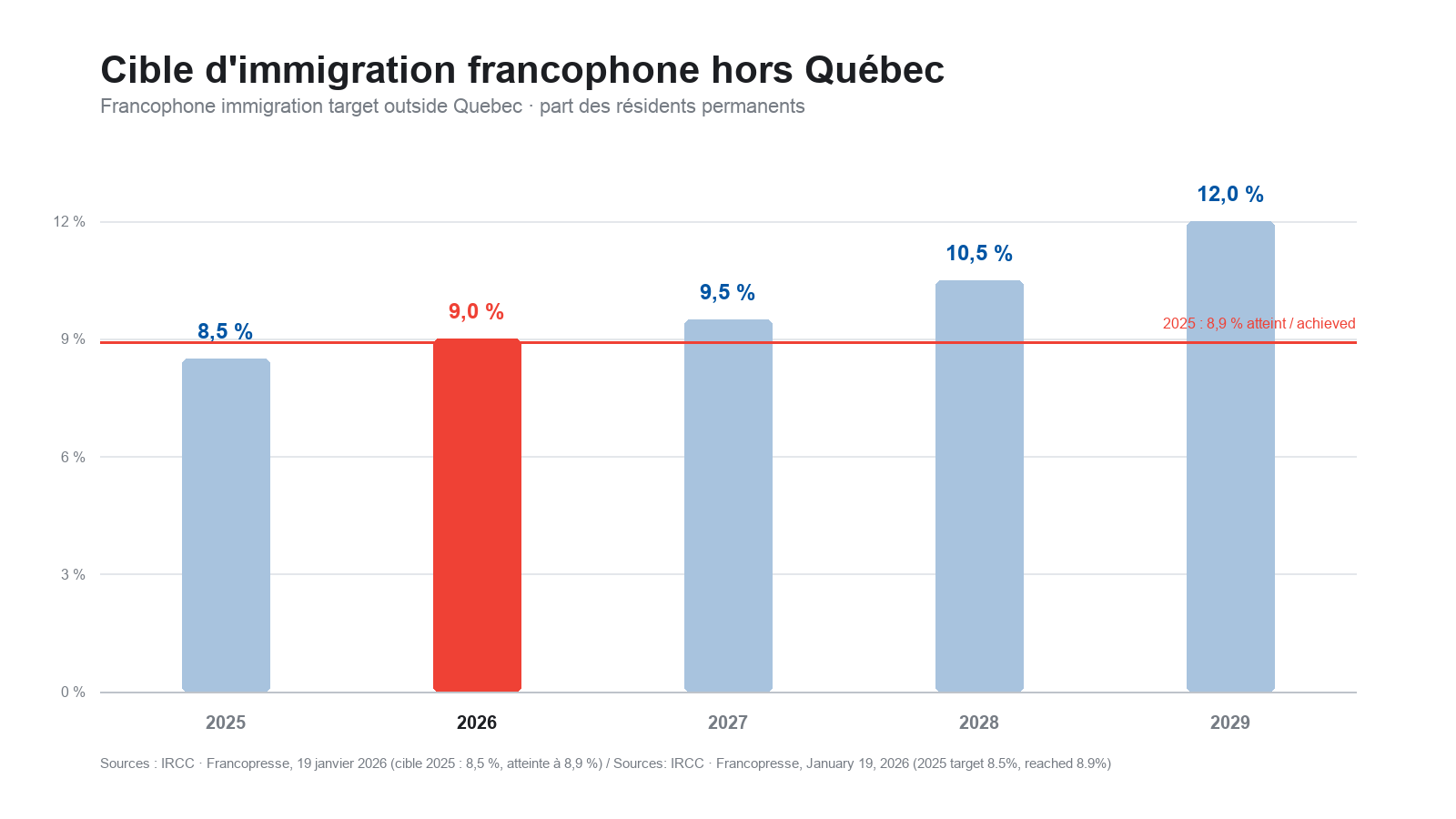
- The federal government has set francophone immigration targets: 9% of new permanent residents outside Quebec should be French speakers in 2026, then 9.5% in 2027 and 10.5% in 2028, and the government has committed to set a 12% target by 2029.
That last point is the key one. It is a policy commitment, not marketing.
Impact on Express Entry
Direct bonus points: 25 or 50
If you reach CLB 7 / NCLC 7 (roughly B2) in all four French abilities, you earn extra points:
| Your English level | Extra points |
|---|---|
| CLB 4 or below (or no English results) | +25 |
| CLB 5 or higher (in all four abilities) | +50 |
These are additional points, added on top of your score from the other factors.
Separate draws: cut-offs about 100 points lower
French-language proficiency is its own Express Entry category. In 2026, French-category draws total 12 rounds and 60,500 invitations, with CRS cut-offs between 382 and 435.
Over the same period, cut-offs for other categories (such as Canadian Experience Class) are often between 510 and 520.
What this means: you aren’t competing with everyone, you’re competing with people who speak French.
French-speaking work permit: no LMIA
The “Francophone Mobility” stream allows Canadian employers to hire French speakers without an LMIA. For people who want to work first and immigrate later, this is a much more realistic route than finding an employer willing to go through the LMIA process.
A reminder
The points depend on a language test result, which must be less than 2 years old when you create your Express Entry profile and again when you submit your permanent residence application. Before you calculate your score, check the date on your result. To convert your scores into levels, see the NCLC/CLB converter.
Impact on work
Bilingual jobs are a requirement, not a bonus
| Field | Situation |
|---|---|
| Federal public service | Many positions are designated “bilingual imperative”: without the required level, you can’t take the job |
| Education | French immersion schools have been short of teachers for a long time; bilingualism is a condition of hiring |
| Health and social services | Positions serving francophone communities require French |
| Customer service and sales | National companies often run a bilingual line |
| Immigration, law, translation | French is part of the ability to practise |
The bilingual bonus: an honest word
The federal public servant bilingual bonus is $1,120 per year. It was set in 1977 and has not increased since. Adjusted for inflation, it would be worth about $5,180 today.
So don’t learn French for the $1,120. The real value is elsewhere: bilingual positions keep out people who don’t speak French, and if you can get in, the salary and stability follow. The bonus is only symbolic.
Many schools won’t tell you this, because it isn’t very inspiring. But it can be checked: look at the IRCC or Department of Finance websites. We would rather tell you first.
Impact on daily life
Children. Canada has French Immersion classes, and enrolment does not require parents to speak French. But if you do, your child’s reading and writing keep up better. This is a real pain point for many families: parents can’t help with French homework.
Community. Outside Quebec there are active French-speaking communities, cultural events, French-language schools and media. Speaking French means access to another social circle, not just one more skill. See our guide to francophone life in Toronto.
Travel. France, Belgium, Switzerland, Quebec, and many French-speaking countries in Africa are all open to you.
Cognition. Learning a second language helps attention and memory, and research supports this. But don’t overstate it: it isn’t a reason to learn French, just a side benefit afterwards.
Five common misconceptions
| Misconception | Reality |
|---|---|
| “French is too hard for me” | Pronunciation is the hard part; the grammar is actually more regular than English |
| “A DELF earns me points” | No. DELF is a diploma that IRCC does not recognize; only TEF Canada and TCF Canada count |
| “At B2 I can take part in meetings” | Not necessarily. B2 is an exam standard; workplace speaking needs specific practice |
| “French takes ten years to become useful” | Going from zero to B2 takes about 500 hours of effective study, and CLB 7 / NCLC 7 corresponds roughly to B2 (an approximation: IRCC publishes score-to-CLB tables, not CEFR levels) |
| “I’m too old to learn” | For adults, the bottleneck is usually time invested, not age |
How long does it take?
From zero to B2 takes about 500 hours of effective study. Our full pathway is 330 class hours plus self-study, about 14 months; full-time is 300 class hours over 12 weeks. The 12-week full-time programme reaches B1, not B2: see Bundles and Learning paths.
| Your weekly commitment | Approximate time to CLB 7 / NCLC 7 |
|---|---|
| 6 class hours + 6 hours of self-study | about 14 months |
| 3 class hours + almost no self-study | We advise against starting: you would keep stalling at A2 |
The last row is the truth. We have seen too many people sign up, reach A2, stop for six months, then start over. To estimate your budget, try the cost calculator.
Find your level
Not sure where you stand? Take a placement test: 40 minutes, free. You leave with a specific number and a specific path.
Data sources
| Content | Source |
|---|---|
| 25 / 50 point rule for French | IRCC: Express Entry for French-speaking skilled workers, page updated August 20, 2025 |
| 2026 French-category draws (12 rounds / 60,500 / 382–435) | IRCC, rounds of invitations (consulted 2026-11-04); 12 rounds also confirmed by CIC News, October 27, 2026 |
| Francophone immigration targets (9% in 2026, 12% in 2029) | Francopresse, January 19, 2026 (9% in 2026 and 12% in 2029); IRCC note to the House of Commons immigration committee, April 20, 2026 (9.5% in 2027, 10.5% in 2028, commitment to set 12% by 2029) |
| $1,120 bilingual bonus | Library of Parliament research paper 2017-29-E, updated January 20, 2026 |
Source for the figure on French in the world (about 320 million speakers): OIF 2022 (321 million). OIF’s 2026 report estimates about 396 million.